
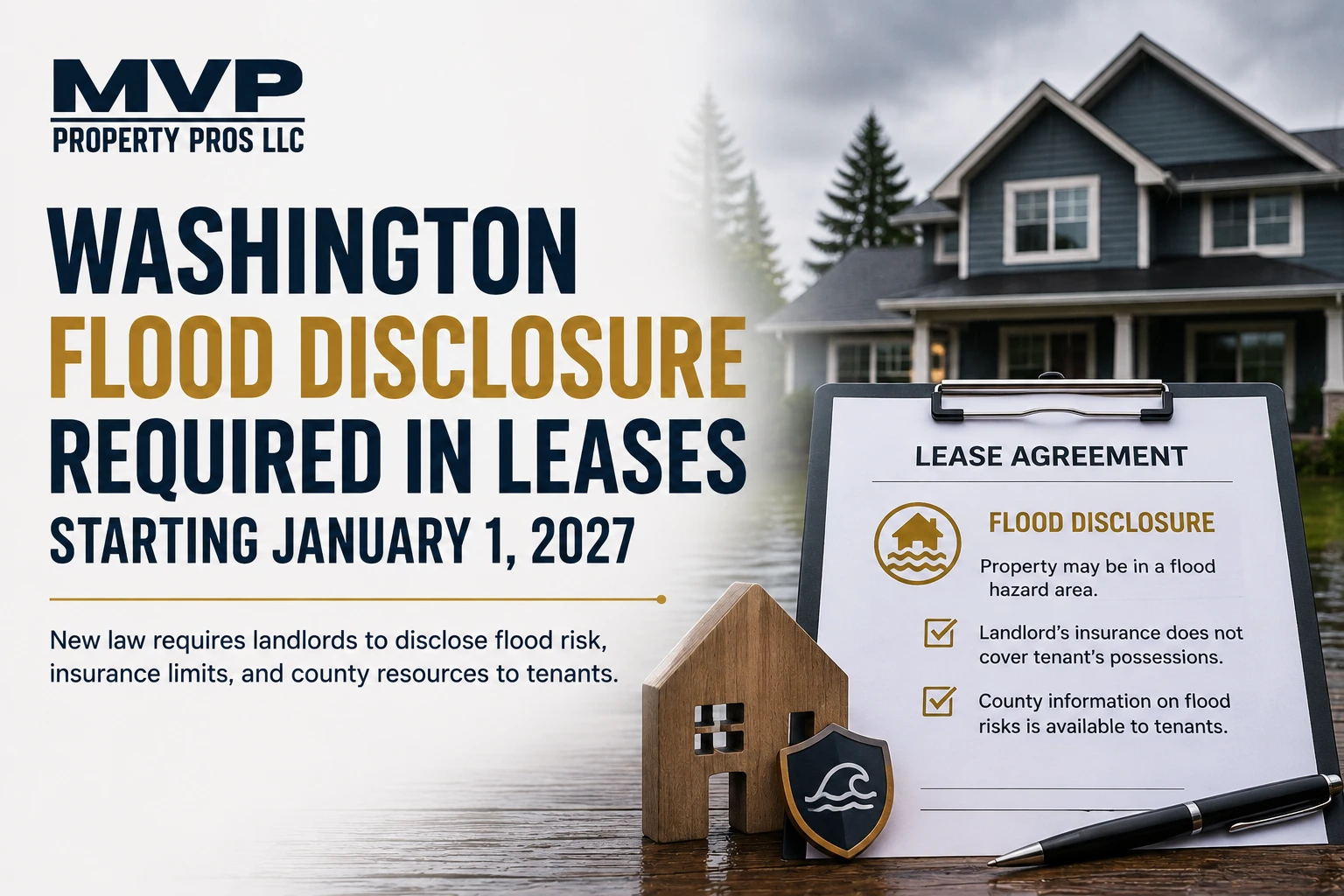
Every Washington lease signed from January 1, 2027 has to carry a flood disclosure. Substitute Senate Bill 6237, Chapter 234 of the 2026 laws, was signed on March 27, 2026 and adds a new subsection (13) to RCW 59.18.060, the statute that lists what a landlord must do. The bill itself took effect on June 11, 2026, but the duty attaches to the lease, and the session law says the disclosures apply only to leases entered into after December 31, 2026.
That gap is the useful part. There is time to get the wording right, get it into the lease template, and work out which of your properties actually sit in a flood area, rather than discovering all three at once in January.
The three disclosures, and what they actually say
Subsection (13) requires the landlord to disclose three things to the tenant:
- That the property may be located in a special flood hazard area or an area of potential flooding.
- That the landlord’s insurance does not cover the loss of the tenant’s personal possessions, and that the tenant should consider purchasing renter’s insurance and flood insurance.
- That information about hazards that may affect the property, including whether the property may be at risk of flooding, is available from the county government.
Read the first one carefully, because the wording is doing something specific. The statute says the property may be located in such an area. It is framed as notice of a possibility that the tenant should look into, not a certification by the landlord that the property is or is not in a flood zone. That is a lighter duty than a seller disclosure, and it is deliberately paired with the third item pointing the tenant at the county.
The second item is the one tenants will actually act on, and it is worth landlords understanding it too. Landlord insurance covers the building. It does not cover the tenant’s furniture, electronics or clothing, and standard renter’s insurance policies commonly exclude flood. Those are two separate products, which is why the statute names both.
What the statute does not say
This matters as much as what it does say, and most coverage of the bill glosses over it.
| Question | What the statute provides |
| Is a specific form required? | No form is prescribed. The statute states the content, not the format. |
| Must it be a separate signed notice? | Not stated. The duty is tied to leases entered into after December 31, 2026. |
| Does it apply to advertisements? | The statute addresses leases. It does not extend the duty to advertisements. |
| Is there a stated penalty? | No specific penalty is set for this subsection. |
| Does the mold immunity cover it? | No. The immunity provision in RCW 59.18.060 is written for the mold information subsection, not the new flood subsection. |
| Does the landlord have to determine the flood zone? | Not stated. The disclosure is that the property may be in one, paired with a pointer to county information. |
The immunity point deserves emphasis because at least one published summary of this bill has stated the opposite. The civil immunity language in this section is attached to the mold information subsection. Do not carry that protection across to the flood disclosure in your own planning, and ask your attorney what exposure actually looks like for your property.
Why this lands harder in Thurston County than in most of the state
Thurston County Emergency Management identifies five river systems as the most susceptible to flooding: the Nisqually, Chehalis, Deschutes, Skookumchuck and Black rivers. It also identifies four separate sources of flooding: river and stream, groundwater, tidal, and urban. Flooding can happen at any time of year but is concentrated in the winter months, driven by prolonged rainfall, rapidly melting snowpack, or dam or levee failure.
The county runs river monitoring pages through the season, which is a useful thing to link tenants to in a welcome packet rather than only in a crisis.
High groundwater is the one people miss
A property can be nowhere near a river and still flood here. The county maintains a High Groundwater Map precisely because saturated ground in a wet winter pushes water up into crawlspaces and low-lying yards in areas that no FEMA river map flags. If you own in one of the affected pockets, the FEMA map alone will not tell you what you need to know, and the county lists that map among its determination tools.
How to check whether a specific property is affected
Thurston County publishes the tools, and they are free:
| Tool | What it tells you | Where |
| FEMA Flood Insurance Rate Map | Whether the parcel sits in a mapped special flood hazard area | msc.fema.gov, or the county Building Development Center |
| FIRMette | A printable extract of the FIRM for one parcel, useful as a file record | msc.fema.gov |
| FEMA Flood Insurance Study | Flood history narrative and the engineering behind the maps | Permit Assistance Center |
| High Groundwater Map | Groundwater flooding risk the river maps do not show | County GeoData site |
| Elevation certificates | Recorded elevations and past flood records for specific sites | County records |
| Ask county staff | A determination for your parcel, which the county calls the best method | (360) 754-4023 or flood@co.thurston.wa.us |
Practical advice: do this once per property, save the FIRMette as a PDF in the property file with the date on it, and you have both your answer and your evidence of having looked. The FEMA Map Service Center is the starting point, and the county tools page walks through each option.
Draft disclosure language to take to your attorney
The block below mirrors the statutory wording and adds the county contact details, so a tenant can act on item three without hunting. Treat it as a starting point and not as legal advice. Have your attorney review it before it goes into a lease, because the statute does not prescribe a form and your attorney may prefer it inside the lease body rather than as an addendum.
FLOOD HAZARD DISCLOSURE
1. The Property may be located in a special flood hazard area or an area of
potential flooding.
2. Landlord’s insurance does not cover the loss of Tenant’s personal
possessions. Tenant should consider purchasing renter’s insurance and
flood insurance.
3. Information about hazards that may affect the Property, including whether
the Property may be at risk of flooding, is available from the county
government. In Thurston County, contact the Permit Assistance Center at
(360) 754-4023 or flood@co.thurston.wa.us, or review the FEMA Flood
Insurance Rate Maps at msc.fema.gov.
Tenant signature: ______________________ Date: ____________
Landlord or agent: ____________________ Date: ____________
Two notes on using it. First, if the property is in a mapped special flood hazard area, say so plainly in addition to the statutory wording rather than hiding behind the word may. A tenant who finds out later from a neighbour will not be reassured that you met the minimum. Second, if you require renter’s insurance under the lease, keep that clause separate from this disclosure, because they do different jobs.
The renter insurance conversation this forces
For years the honest answer to why should I buy renter’s insurance was that nobody makes you. From January 2027 the state effectively makes the landlord raise it at signing. That is a good outcome for both sides.
For tenants, the numbers are stark. Landlord insurance covers the structure, so a flooded crawlspace is the owner’s problem, but a flooded ground floor full of the tenant’s belongings is not covered by anything the owner holds. Standard renter’s insurance is inexpensive, and flood is normally a separate policy. Raising it at lease signing, next to the move-in checklist and deposit paperwork, is the moment it actually gets read.
For owners, a tenant with coverage is a tenant who is not looking to you for losses that were never yours to cover. The disclosure costs nothing and removes an argument later.
What else changes on January 1, 2027
The same date brings smart access rules. RCW 59.18.750, effective January 1, 2027, requires a landlord using a smart access system to provide an alternative access method on request that does not rely on biometric data or a mobile phone application. A physical key, a key fob, a key card or a manual keypad all qualify. Related sections address data privacy for those systems, and Washington Law Help summarises the set. We will cover it properly once we have read the sections against the session law, the same way we handled this one.
This is the third new duty added to RCW 59.18.060 and its neighbours in a single year, after the portable cooling device rules in June and the questions that came with wildfire smoke season. The pattern is clear enough: leases written before 2026 are steadily going out of date.
What to do between now and January
- Run every property through the FEMA map and the county high groundwater map, and save the result in the property file with a date.
- Get the disclosure wording reviewed by your attorney and into the lease template, not into a separate document that gets forgotten.
- Decide whether you will require renter’s insurance as a lease term, and keep that clause separate from the disclosure.
- For leases renewing in December, check whether the renewal counts as a lease entered into after December 31 and include the disclosure if there is any doubt. Including it early costs nothing.
- Add the county river monitoring page and the emergency management flood page to your tenant welcome packet.
- While the lease template is open, check the cooling device clause against RCW 59.18.740 as well. Most pre-2026 leases still have language that is no longer enforceable.
Frequently asked questions
When does the Washington flood disclosure requirement start?
The disclosures apply to leases entered into after December 31, 2026. SSB 6237 itself took effect on June 11, 2026, but the duty attaches to the lease, so in practice the first agreements that must carry it are those signed from January 1, 2027 onward.
What exactly does a landlord have to disclose about flooding?
Three things, under the new subsection (13) of RCW 59.18.060. That the property may be located in a special flood hazard area or an area of potential flooding. That the landlord’s insurance does not cover the loss of the tenant’s personal possessions, and that the tenant should consider purchasing renter’s insurance and flood insurance. And that information about hazards affecting the property, including flood risk, is available from the county government.
Does the disclosure have to go in the lease itself?
The statute ties the requirement to leases entered into after December 31, 2026, and does not prescribe a form or a separate notice. Putting it in the lease or in an addendum signed at the same time is the straightforward way to show it was made. Ask your attorney which format they prefer, because the statute leaves the mechanics open.
Does the flood disclosure apply to rental advertisements?
The statute addresses leases. It does not impose the disclosure on advertisements.
What is the penalty for not making the flood disclosure?
The statute does not set a specific penalty for the flood subsection. It is worth noting that the immunity provision in RCW 59.18.060 covers the mold information subsection, not the new flood subsection, so do not assume that protection carries across. Ask your attorney what exposure looks like for your property rather than relying on a general summary.
How do I find out if my rental is in a special flood hazard area?
Thurston County lists several tools: the FEMA Flood Insurance Rate Map and FIRMettes at msc.fema.gov, the FEMA Flood Insurance Study, the county High Groundwater Map on the GeoData site, and flood elevation certificates. The county says the best way to be sure is to speak with staff at the Permit Assistance Center, reachable at (360) 754-4023 or flood@co.thurston.wa.us.
Does the landlord have to buy flood insurance for the tenant?
No. The requirement is a disclosure, not a coverage obligation. The statute has the landlord tell the tenant that the landlord’s insurance does not cover the tenant’s belongings and that the tenant should consider renter’s and flood insurance. Whether the tenant buys it is the tenant’s decision unless the lease requires renter’s insurance separately.
What else changes for Washington rentals on January 1, 2027?
Smart access systems. RCW 59.18.750, effective January 1, 2027, requires a landlord using a smart access system to provide an alternative access method on request that does not rely on biometric data or a mobile phone application, such as a physical key, key fob, key card or manual keypad. Related sections address data privacy for those systems.
Getting your leases ready
MVP Property Pros has managed rental homes in Olympia, Lacey and Tumwater since 2004, and every wet winter it has produced. On managed properties we handle the flood determinations, keep the lease template current with statutes like SSB 6237 rather than a year behind them, and make sure the disclosure is signed rather than assumed. If you self-manage and want your 2027 lease template reviewed before renewal season, get in touch or call (360) 339-8539.
Disclaimer: Information deemed reliable but not guaranteed, and not to be construed as legal advice. Laws and local ordinances change, and how they apply depends on your property and situation. Consult your attorney or your property manager before acting on anything here. Where possible, statements in this article link to the statute, code section or agency publication they are drawn from, so you can verify them directly.
Sources
- SSB 6237 session law, Chapter 234, Laws of 2026, the flood disclosure requirement.
- SB 6237 bill summary and history, signed March 27, 2026.
- RCW 59.18.060, landlord duties, including the new flood disclosure subsection.
- RCW 59.18.750, smart access systems and alternative keys, effective January 1, 2027.
- RCW 59.18.740, portable cooling devices.
- Thurston County Emergency Management, flood hazards, the five river systems and four flood types.
- Thurston County, tools for determining special flood hazard areas, including the high groundwater map and the Permit Assistance Center contact.
- Thurston County, Chehalis River flood monitoring, seasonal river monitoring.
- FEMA Map Service Center, flood insurance rate maps and FIRMettes.
- Washington Law Help, 2026 changes affecting renters, overview of the 2026 and 2027 changes.