
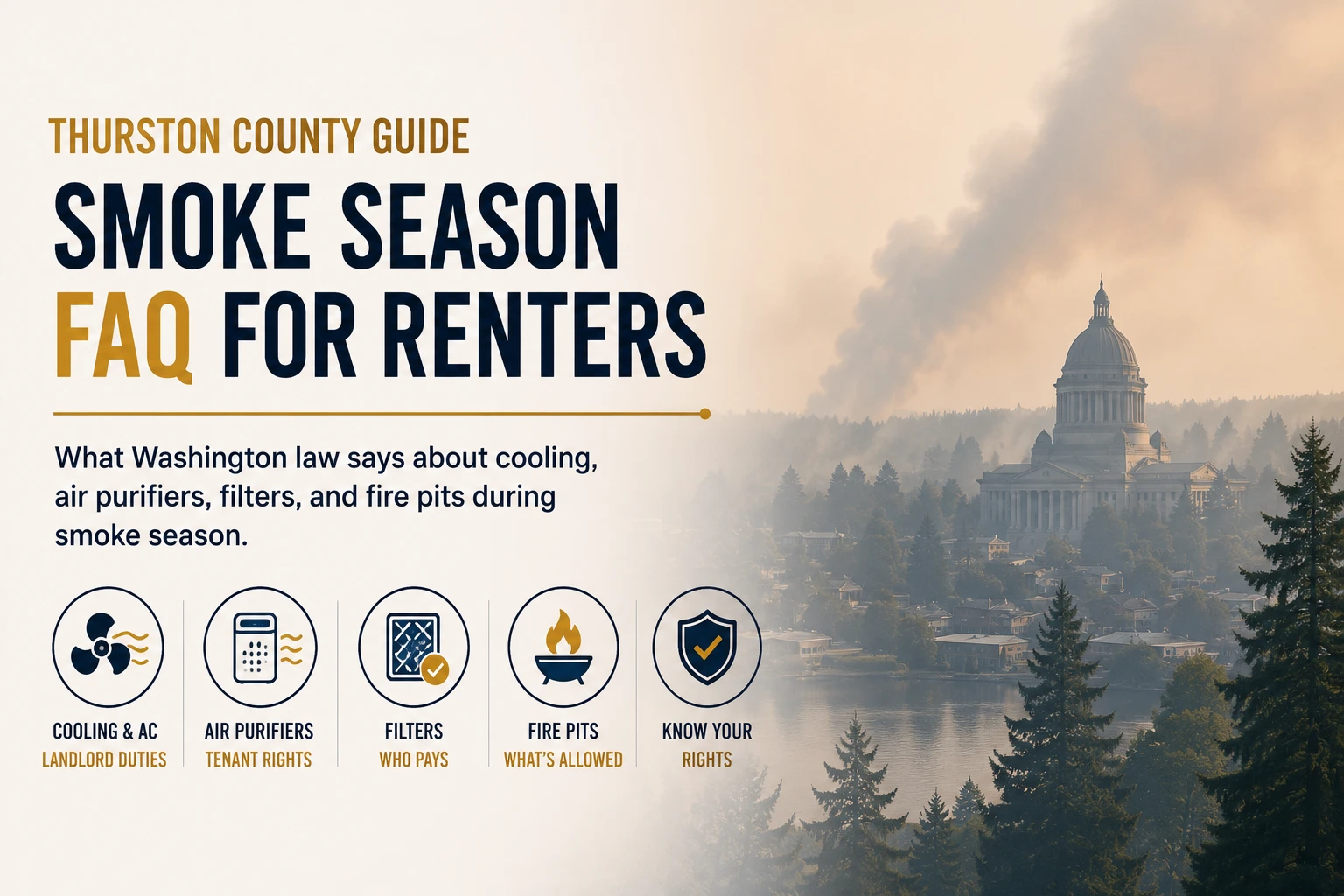
Smoke reached Thurston County again this month. On August 3, 2026 smoke from eastern Washington fires pushed into the Puget Sound lowlands, and by August 4 the Olympic Region Clean Air Agency reported that a National Weather Service air quality alert covering Thurston County had been extended to Mason and Grays Harbor, running through the afternoon of August 6. The Washington Smoke Blog recorded unhealthy air across the I-5 corridor during those days, and fires east of the Cascades were still producing smoke as of August 20.
Every August the same questions arrive from both sides of a lease. Does the landlord have to provide air conditioning. Can the tenant put in a window unit. Who pays for an air purifier. Who is responsible for the filters. Can anyone light a fire pit. Below is what Washington law actually says on each, with the statute linked so you can check it yourself rather than take our word for it.
Does a Washington landlord have to provide cooling or air filtration?
No, and it is worth being direct about that rather than implying otherwise. RCW 59.18.060 is the statute that lists what a landlord must do, and cooling does not appear on the list. What does appear:
- Subsection (9): maintain the dwelling unit in reasonably weathertight condition.
- Subsection (11): provide facilities adequate to supply heat and water and hot water as reasonably required by the tenant.
- Subsection (8): maintain all electrical, plumbing, heating and other facilities and appliances supplied by the landlord in reasonably good working order.
That last one is where most smoke season disputes actually land. There is no duty to install air conditioning. But if the property came with a heat pump, a central system or a wall unit, subsection (8) requires it to be kept working, and that includes the filter housing and the fan that the tenant will be relying on to clean indoor air.
Subsection (9) matters too. Smoke finds the same gaps that cold air finds. If a tenant reports smoke pouring in around a warped sash or a door that no longer seals, that is a weathertight question, not a comfort question, and it belongs in the maintenance queue.
How fast does a repair have to happen?
RCW 59.18.070 sets the clock once the tenant gives written notice. Twenty four hours where the defect deprives the tenant of hot or cold water, heat or electricity, or is imminently hazardous to life. Seventy two hours for a refrigerator, range and oven, or a major plumbing fixture supplied by the landlord. Ten days in all other cases.
A landlord-supplied cooling unit that quits sits in that ten day bucket, not the twenty four hour one, unless something about the situation makes it imminently hazardous. Knowing which bucket applies keeps expectations reasonable on both sides during a week when every HVAC company in the county is booked.
The portable cooling device law, and exactly where it stops
This is the change most renters have heard about and most leases have not caught up with. ESSB 6200, effective June 11, 2026, provides that a landlord may not prohibit or restrict a tenant from installing a portable cooling device of the tenant’s choosing. The statute defines that device as an air conditioner or portable heat pump, including a device mounted in a window or designed to sit on the floor.
A tenant must give at least two days notice before installing a window-mounted unit. Floor units need no notice. We covered the full mechanics in our guide to the portable AC law, including the lease language owners should be updating.
The exceptions in the statute are real and specific, and a landlord may restrict a device where the installation:
- Violates building codes, state law or federal law.
- Violates the manufacturer’s safety guidelines.
- Causes unreasonable damage or renders the premises uninhabitable.
- Requires an electrical supply the existing service cannot accommodate.
- Is window-mounted and interferes with egress, interferes with window locking, or cannot be secured.
- Is window-mounted and the property insurance policy expressly restricts such devices.
Note what the list does not include: a general no appliances clause, an aesthetic preference, or a fee. If you are refusing a device, the refusal has to sit on one of those six grounds and you should be able to say which one.
Air purifiers are a separate question
Here is the distinction that gets blurred in most coverage of this law. ESSB 6200 covers cooling devices. A HEPA air cleaner does not cool anything, so it is not a portable cooling device under the statute and the statute does not reach it.
In practice that rarely creates a problem, because an air cleaner is not an installation. It plugs into a standard outlet like a lamp, so nothing is being mounted, altered or attached. But it does mean a tenant cannot point to ESSB 6200 as the source of a right to run one, and it means an owner who wants to be genuinely helpful during smoke season should simply say yes in writing rather than leaving it ambiguous.
What actually keeps smoke out of a rental
The Washington State Department of Health publishes the practical guidance, and it is short enough to summarise honestly:
| Measure | What DOH says | Who normally handles it |
| HVAC filter | Use a MERV 13 rated filter, or the highest rated filter the system can handle | Landlord supplies, tenant changes, unless the lease says otherwise |
| System setting | Set the system to recirculate and run continuously on fan mode | Tenant, during the event |
| Portable air cleaner | Filter only, with a HEPA filter, sized for the room. No ionic, ozone or ultraviolet units | Tenant, in most tenancies |
| DIY box fan filter | A 20 by 20 inch MERV 13 filter attached to a box fan. DOH notes box fans are not designed to run with a filter attached | Tenant |
| Cleaner air room | Set up one room in the home to hold cleaner air through the event | Tenant |
| N95 masks | For short periods indoors where windows cannot stay closed. Filters fine particles but not gases | Tenant |
Two practical notes for owners. First, a higher MERV filter restricts airflow, so check what the system is rated for before jumping to MERV 13 on an older furnace. Second, if the lease makes filter changes the tenant’s job, say so plainly and supply the right size, because a filter nobody has changed since spring is the most common reason a system underperforms exactly when it matters. Our post on tenant maintenance responsibilities covers where that line normally sits.
Entry, inspections and filter changes during a smoke event
If a landlord or manager needs to get in to swap filters or check a system, RCW 59.18.150 still governs. At least two days written notice to inspect or make repairs. At least one day to show the unit. The tenant may not unreasonably withhold consent, and repeated unlawful entry after written notice carries liability of up to $100 per violation plus attorney fees.
Smoke is not an emergency exception. Plan the visit, give the notice, and if the tenant would rather change the filter themselves, mail them one. Our inspection preparation post covers what a routine visit should look like.
If anyone works on your property, the wildfire smoke rule applies to you
This one catches self-managing owners out. Chapter 296-820 WAC is Washington’s wildfire smoke rule for workplaces, and it applies to all workplaces, with exemptions for enclosed buildings with windows and doors closed, enclosed vehicles with cabin air filters, firefighting work and prescribed burns. Outdoor work on a rental property is not exempt.
The hazard communication section sets the first trigger at two consecutive current PM2.5 readings of 20.5 micrograms per cubic metre, printed in the rule as AQI 72, at which point the employer must communicate the level and the protective measures available. The next tier is 35.5 micrograms, printed as AQI 101, where exposure controls apply and N95 respirators must be made available for voluntary use. Higher tiers follow above that.
If you have employees, or crews you direct, painting, roofing, landscaping or turning a unit during a smoke event, this is a compliance obligation and not a suggestion. If you use independent contractors, it is their obligation for their own people, but it is worth confirming they know it exists.
Where the Thurston County burn ban stands
Different smoke, same season, and a genuinely common tenant question. Thurston County officials, in consultation with the county Fire Marshal, the Director of Emergency Services, the Fire Chiefs Association and ORCAA, called a fire safety burn ban effective July 8, 2026, running through October 15, 2026.
| Activity | Status under the 2026 ban | Notes |
| Residential yard waste burning | Prohibited in unincorporated areas | Banned year round inside cities and urban growth areas |
| Land clearing burns | Prohibited | Applies countywide in unincorporated areas |
| Recreational campfire | Allowed | Only when built and contained within an established fire ring |
| Charcoal briquettes | Allowed | Standard barbecue use |
| Gas, pellet and propane grills | Allowed | Standard barbecue use |
The year round point matters here because most of our managed properties sit inside it. Yard waste burning is permanently banned within Thurston County cities and urban growth areas, including Bucoda, Grand Mound, Lacey, Olympia, Rainier, Tenino, Tumwater and Yelm, following the state prohibition on burning in designated urban growth areas that took effect on January 1, 2007. ORCAA maintains a current status page by county, and Thurston County publishes its own burn ban page. Restrictions can tighten mid season, so check on the day rather than relying on what was true in July.
For leases, the practical answer is to be specific rather than silent. A clause that says open flames and outdoor burning must comply with current Thurston County and ORCAA restrictions, with a link, ages better than a blanket ban that everyone ignores or a permission that becomes wrong in September.
Smoke, cleaning and the security deposit
After a heavy smoke week, fine particulate settles on sills, blinds and surfaces throughout the neighbourhood. That is not tenant damage. RCW 59.18.280 provides that no portion of a deposit may be withheld for wear resulting from ordinary use of the premises, and it requires a full and specific statement of anything withheld, with documentation, within 30 days after the tenancy ends and the tenant vacates. Miss that and the landlord is liable for the full deposit, with up to double plus attorney fees where the refusal was intentional.
A blackened filter at move-out is worth a moment of honesty in the same vein. If the lease made filter changes the tenant’s responsibility and the tenant never changed one all year, that is a conversation. If a filter went dark during three unhealthy air weeks in August, that is the filter doing its job.
A short checklist for owners
- Check now whether any lease still bans portable air conditioners, and rewrite the clause against the six statutory exceptions rather than leaving it as a flat prohibition.
- Confirm the filter size and rating for each system and put both in the lease or the welcome packet, so nobody guesses in August.
- Treat smoke coming in around windows and doors as a weathertight item under RCW 59.18.060(9), not a comfort complaint.
- Give proper entry notice before any smoke-related visit, two days for repairs and inspections.
- If you direct anyone doing outdoor work, know where the WAC 296-820 triggers sit before the next alert.
- Put current burn restrictions in the lease by reference, not by fixed dates that expire.
A short checklist for tenants
- You may install a portable cooling device. Give two days notice for a window unit, none for a floor unit, and no fee applies.
- Report a failed landlord-supplied system in writing, because the RCW 59.18.070 clock starts on written notice.
- Report smoke coming in around windows and doors specifically, using the word weathertight, because that is the statutory duty it falls under.
- Run the system on recirculate and continuous fan, and close what you can, per DOH guidance.
- Change the filter if that is your job under the lease, and ask for the right size if you do not have one.
- Photograph the unit before and after a heavy smoke week, so deposit conversations later start from evidence.
Frequently asked questions
Does a landlord have to provide air conditioning in Washington?
No. RCW 59.18.060 lists the landlord duties and cooling is not among them. The statute requires the unit to be kept in reasonably weathertight condition and requires facilities adequate to supply heat, water and hot water. If the landlord did supply an air conditioner or a heat pump, then RCW 59.18.060(8) requires it to be kept in reasonably good working order.
Can a landlord stop a tenant using a portable air conditioner during smoke season?
Generally no. Under ESSB 6200, effective June 11, 2026, a landlord may not prohibit or restrict a tenant from installing a portable cooling device of the tenant’s choosing, subject to listed exceptions covering building and safety codes, manufacturer guidance, unreasonable damage, inadequate electrical service, interference with egress or window locking, and an express insurance restriction on window-mounted units. A window-mounted unit needs at least two days notice to the landlord.
Does that law cover air purifiers as well?
No. ESSB 6200 defines a portable cooling device as an air conditioner or portable heat pump, including a device mounted in a window or designed to sit on the floor. A HEPA air cleaner is not a cooling device, so it is not covered by that statute. It is also not an installation, since it plugs into a standard outlet, so in practice it is treated like any other tenant appliance under the lease.
How long does a landlord have to fix a broken air conditioner?
RCW 59.18.070 sets 24 hours where the defect deprives the tenant of hot or cold water, heat or electricity, or is imminently hazardous to life, 72 hours for a refrigerator, range and oven or a major plumbing fixture, and 10 days in all other cases. A landlord-supplied cooling unit that fails falls into the 10 day category unless the circumstances make it imminently hazardous.
Can a landlord enter to change HVAC filters during a smoke event?
Yes, with notice. RCW 59.18.150 requires at least two days written notice to inspect or make repairs, and at least one day to show the unit. The tenant may not unreasonably withhold consent. Repeated unlawful entry after written notice carries liability of up to $100 per violation plus attorney fees.
Is there a burn ban in Thurston County right now?
Yes. Thurston County officials called a fire safety burn ban effective July 8, 2026 running through October 15, 2026. It prohibits residential yard waste burning and all land clearing burns in unincorporated areas. Recreational campfires within an established fire ring are still allowed, as are charcoal briquettes, gas, pellet grills and propane barbecues. Yard waste burning is banned year round inside the cities and urban growth areas, including Olympia, Lacey, Tumwater and Yelm. Check the county and ORCAA pages before lighting anything, because restrictions can tighten quickly.
Can a landlord charge a tenant for smoke smell or soot after move-out?
Only for damage beyond ordinary use. RCW 59.18.280 states that no portion of a deposit may be withheld for wear resulting from ordinary use of the premises, and the landlord must give a full and specific statement with documentation within 30 days of the tenancy ending and the tenant vacating. Fine particulate settling on surfaces during a regional smoke event is not tenant damage, and a clogged filter the landlord is responsible for supplying is not either.
Managing through smoke season in Thurston County
MVP Property Pros has managed rental homes in Olympia, Lacey and Tumwater since 2004, through every smoke season the last two decades have produced. On managed properties we keep filters specified and stocked, handle the entry notices, keep lease clauses current with laws like ESSB 6200 rather than a year behind them, and take the August calls so owners do not have to. If you self-manage and want your lease checked before the next alert, get in touch or call (360) 339-8539.
Disclaimer: Information deemed reliable but not guaranteed, and not to be construed as legal advice. Laws and local ordinances change, and how they apply depends on your property and situation. Consult your attorney or your property manager before acting on anything here. Where possible, statements in this article link to the statute, code section or agency publication they are drawn from, so you can verify them directly.
Sources
- RCW 59.18.060, landlord duties, including weathertight condition and maintenance of supplied facilities.
- RCW 59.18.070, repair timelines after written notice.
- RCW 59.18.150, entry notice requirements.
- RCW 59.18.280, deposit accounting, ordinary wear and the 30 day deadline.
- ESSB 6200 session law, portable cooling devices, effective June 11, 2026.
- Chapter 296-820 WAC, the Washington wildfire smoke rule for workplaces.
- WAC 296-820-820, hazard communication thresholds.
- Washington State Department of Health, protecting yourself from smoke, filtration and cleaner air room guidance.
- ORCAA, wildfire smoke lingers in western Washington, the August 2026 air quality alert for Thurston, Mason and Grays Harbor.
- Washington Smoke Blog, August 2026, daily smoke conditions.
- ORCAA, Thurston fire safety burn ban starting July 8, 2026, the current ban and its terms.
- ORCAA, county burning restrictions, current status and the year round urban growth area rule.
- Thurston County burn ban information, county page.