
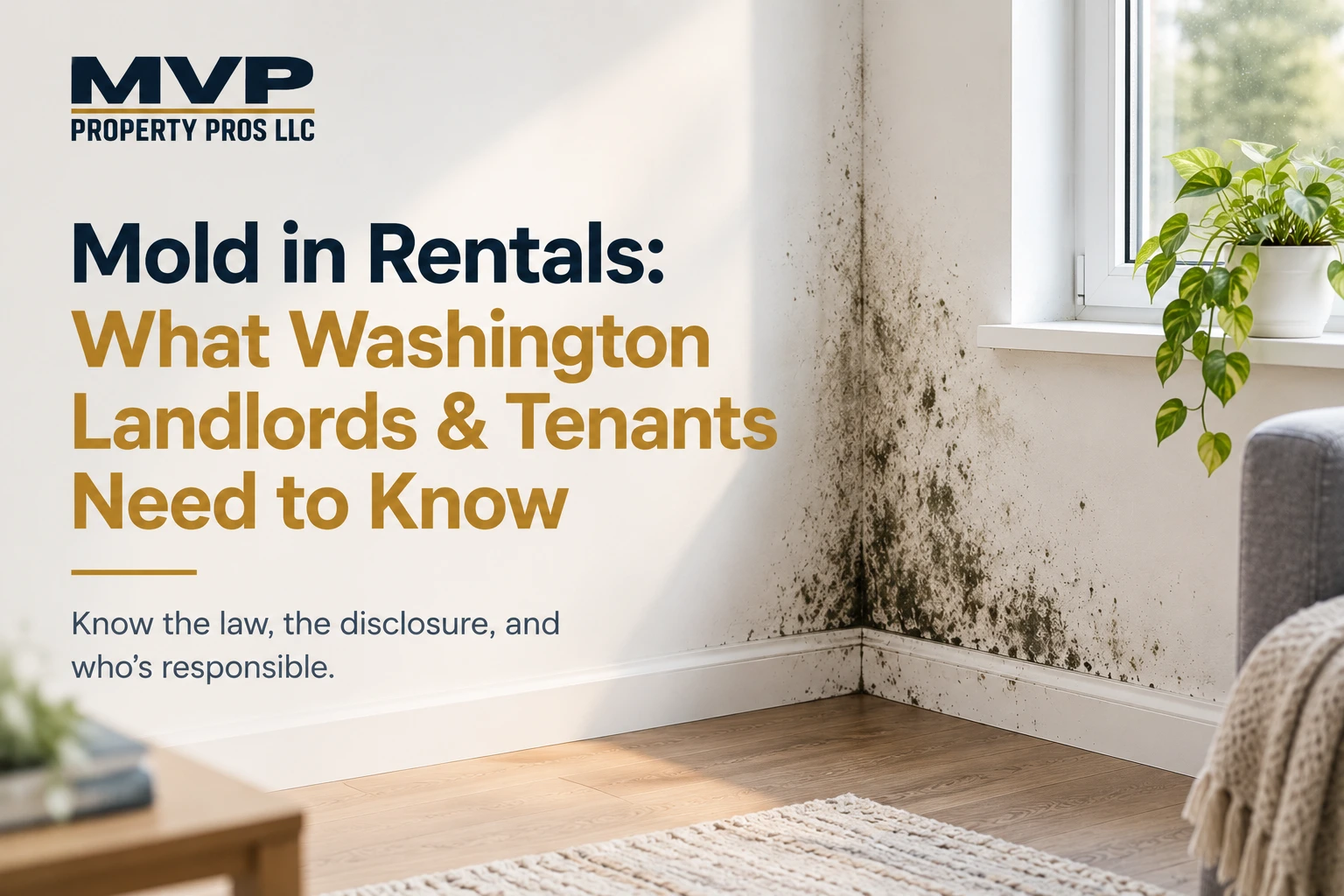
Mold questions follow the first heavy rain every year, and the law here is narrower than most people assume on both sides. Washington does not require a landlord to certify a unit is mold-free, and it does not put a codified duty on tenants to prevent mold. What it actually requires is more specific than either of those, and worth knowing exactly.
The disclosure duty, precisely
Under RCW 59.18.060(14), a landlord must provide tenants with information about the health hazards associated with exposure to indoor mold, and how to control mold growth to minimize those health risks. It can be given individually in writing, most commonly at lease signing, or posted in a visible location at the property.
Read that again: it is a general information duty, not a disclosure that a specific unit has or has had mold. A landlord complies by handing over the right information at the start of the tenancy, not by inspecting for or certifying the absence of mold.
Washington makes this easy to comply with. The Department of Health publishes Mold Questions and Answers, printable in English and Spanish, built for exactly this purpose. The EPA’s Brief Guide to Mold, Moisture, and Your Home works the same way. Either one, handed over or posted, satisfies the statute.
The immunity, and how narrow it actually is
This is the part most secondary sources get wrong in one direction or the other. RCW 59.18.060(15) gives the landlord and their agents and employees civil immunity for failure to comply with the mold information duty in subsection (14), except where the failure to comply is knowing and intentional.
Read carefully, this cuts both ways. A landlord who genuinely forgot, or never knew the duty existed, is protected by that immunity for the omission itself. A landlord who was told about the requirement, perhaps by a tenant, an attorney, or a previous complaint, and kept not doing it, is in a meaningfully different position, because that starts to look like the knowing and intentional failure the statute carves out of the protection.
The immunity is specific to subsection (14). It is not a general shield for mold-related habitability problems, and it does not touch the landlord’s separate duty to maintain the dwelling in reasonably weathertight condition, which sits in a different subsection entirely.
Where the actual habitability duty comes from
Mold is usually a symptom, not the underlying problem. RCW 59.18.060(9) requires a landlord to maintain the dwelling unit in reasonably weathertight condition. A leaking roof, a failed window seal, or a plumbing leak that lets water into a wall cavity is a weathertightness or maintenance failure, and the mold growing from it is the visible symptom of that underlying defect.
That distinction matters for the repair clock. RCW 59.18.070 sets 24 hours for a defect depriving the tenant of heat, water or electricity or imminently hazardous to life, 72 hours for a major appliance or plumbing fixture, and 10 days for everything else. Mold itself is not named in any of the three tiers. What gets evaluated against those tiers is the actual underlying defect, once it is identified, which is exactly why the honest first step after finding mold is getting the source diagnosed rather than guessing at a deadline.
What Washington law does not put on tenants
This deserves a direct statement because it is commonly assumed and rarely stated. RCW 59.18.130, the statute setting tenant duties, requires keeping the occupied space clean and sanitary, properly disposing of waste, and properly using appliances the landlord supplied. It does not contain a codified duty to run ventilation, control humidity, or otherwise prevent mold growth.
That is a legal point, not a practical one. The Washington Department of Health separately recommends, as good practice rather than statutory command, that tenants operate heating and ventilation systems to reduce water condensation and notify the landlord promptly in writing of any leak or moisture problem. Following that guidance is still the right move for a tenant who wants a healthy home and a strong paper trail. It is simply not something the statute requires of them the way subsection (14) requires something of the landlord.
What actually causes indoor mold, and where responsibility usually sits
| Cause | Usually whose problem |
| Roof leak, failed window seal, plumbing leak in a wall | Landlord, under the weathertight and maintenance duties |
| Long-term condensation from inadequate ventilation the unit does not have | Often a building or design issue, evaluate case by case |
| Tenant not running exhaust fans or opening windows during showers or cooking | Contributing tenant factor, not a codified duty, but relevant to a dispute |
| A single water event, such as an overflowed tub, reported late | Depends heavily on when it was reported and in what form |
None of these categories is a bright line in the statute. What decides most real disputes is timing and documentation: when the moisture problem was reported, whether that report was in writing, and how quickly the landlord responded once notified.
What to do in the first week, either side
- Tenant: report it in writing immediately, describe the location and size, and photograph it with a visible date.
- Landlord: get the source diagnosed before treating the symptom. Painting over mold without fixing the moisture source is the single most common mistake and it makes the problem worse, not better.
- Both sides: keep every message. If this becomes a dispute later, the written record is what it turns on, not memory.
Frequently asked questions
Is a landlord required to tell tenants about mold in Washington?
Yes, but not the way most people assume. RCW 59.18.060(14) requires the landlord to provide information about the health hazards associated with exposure to indoor mold and how to control mold growth. It is a general information duty, not a requirement to disclose mold in a specific unit or to certify the unit is mold-free.
How is the mold notice supposed to be given?
In writing to each new tenant when the lease or rental agreement is signed, or posted in a visible location at the property. The Washington State Department of Health publishes a ready-made fact sheet, Mold Questions and Answers, in English and Spanish, that a landlord can print and hand over to satisfy this.
What happens if a landlord never gives the mold notice?
RCW 59.18.060(15) gives the landlord civil immunity for failing to comply with the mold information duty, except where the failure to comply is knowing and intentional. In practice that means an oversight is unlikely to create liability by itself, while a landlord who is told about the requirement and deliberately ignores it is in a different position.
Does Washington law make tenants responsible for preventing mold?
Not explicitly. RCW 59.18.130 sets tenant duties around cleanliness, proper waste disposal, and properly using appliances the landlord supplied. It does not contain a specific duty to run ventilation or otherwise prevent mold. The Department of Health separately recommends that tenants operate heating and ventilation systems to reduce condensation and report leaks or moisture promptly in writing, but that is health guidance, not a codified legal duty in this statute.
Is mold automatically a repair the landlord must fix within 24 hours?
Not automatically. RCW 59.18.070 sets a 24 hour deadline for a defect that deprives the tenant of heat, water or electricity, or is imminently hazardous to life, 72 hours for a major appliance or plumbing fixture, and 10 days for everything else. Where mold is a symptom of a structural leak or a weathertightness failure under RCW 59.18.060(9), the underlying defect gets evaluated under those same tiers based on what it actually is. Surface mold with no known structural cause does not fall neatly into any of them, and the honest answer is that it needs an inspection to determine which category applies.
What should a tenant do first if they find mold?
Report it in writing immediately, describing where it is and how large the area is, so there is a dated record. The Department of Health also recommends operating ventilation to reduce condensation while waiting for a response. Photograph the area with a visible date.
Where can I get a landlord mold notice to use right now?
The Washington State Department of Health publishes Mold Questions and Answers in English and Spanish, free to print. The EPA also publishes A Brief Guide to Mold, Moisture, and Your Home in both languages. Either satisfies the information duty in RCW 59.18.060(14).
Handling mold reports on a managed property
MVP Property Pros has managed rental homes in Olympia, Lacey and Tumwater since 2004, through every wet winter this region produces. On managed properties the mold information notice goes out at every lease signing, moisture reports get a same-week inspection rather than a paint job, and the underlying cause gets fixed before the symptom does. If you self-manage and want your move-in packet reviewed, get in touch or call (360) 339-8539.
Disclaimer: Information deemed reliable but not guaranteed, and not to be construed as legal advice. Laws and local ordinances change, and how they apply depends on your property and situation. Consult your attorney or your property manager before acting on anything here. Where possible, statements in this article link to the statute, code section or agency publication they are drawn from, so you can verify them directly.
Information deemed accurate as of September 2026 but not guaranteed.
Sources
- RCW 59.18.060, landlord duties, subsections (9), (14) and (15).
- RCW 59.18.070, repair timelines.
- RCW 59.18.130, tenant duties.
- Washington State Department of Health, renters, landlords and mold, the information duty and practical guidance.
EPA, A Brief Guide to Mold, Moisture, and Your Home, printable notice option.