
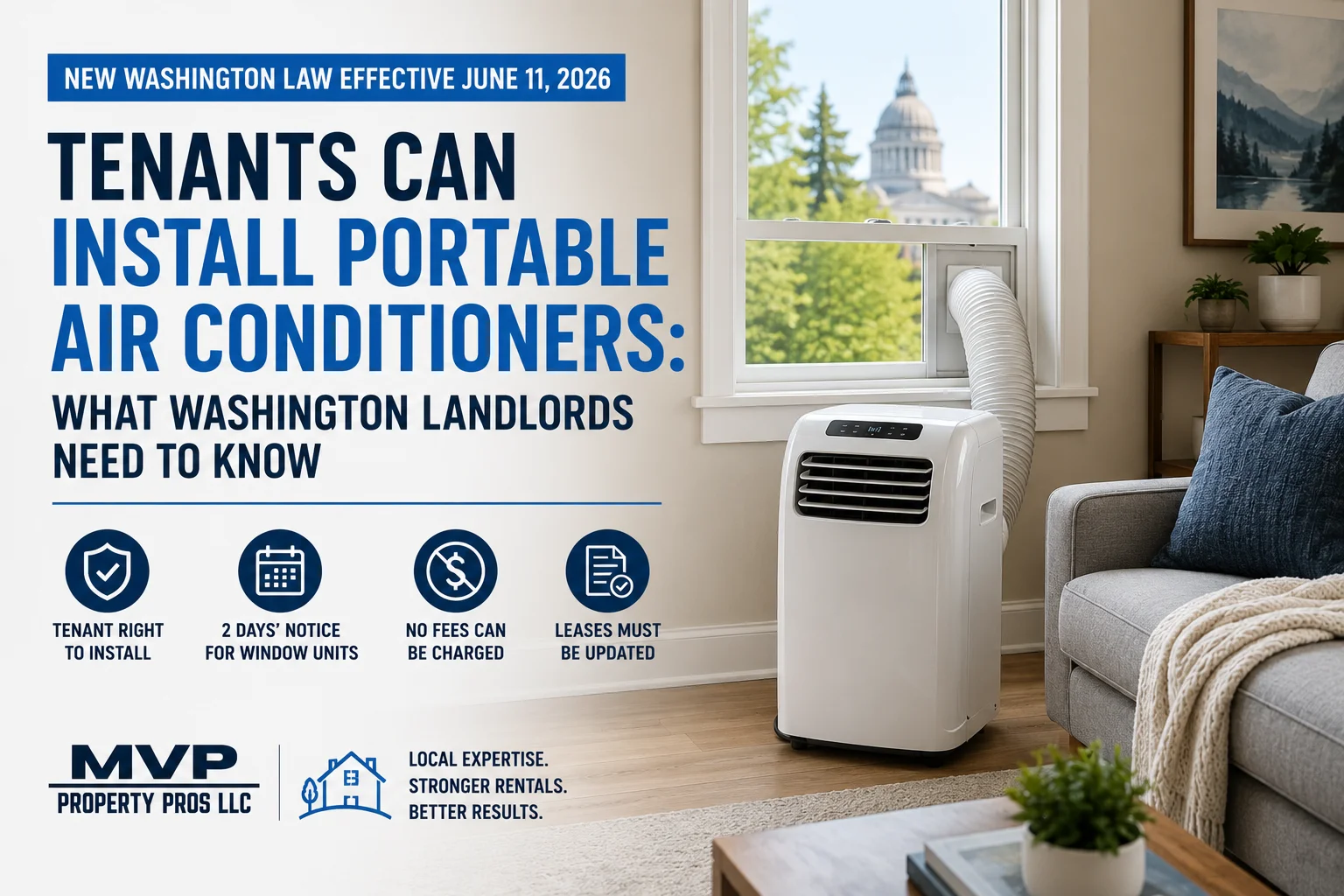
Washington landlords can no longer ban tenants from installing portable air conditioners. Under ESSB 6200, effective June 11, 2026, tenants may install portable cooling devices — including window, saddle, and floor units — and landlords may not charge a fee for installation, use, or inspection. Landlords can still refuse in specific, defined situations, and those situations are the whole ballgame.
If you own a rental in Olympia, Lacey, or Tumwater, this is the change most likely to catch you out this summer. Not because it is complicated, but because it flips a lease clause that thousands of Washington leases have carried for years. If your lease still says “no window air conditioning units,” that clause is now unenforceable as written — and it may also be putting you out of compliance with the notice requirement the same law created.
Here is what actually changed, what you can still say no to, and the four things worth doing before the next heat event.
What changed on June 11, 2026?
Governor Ferguson signed Engrossed Substitute Senate Bill 6200 on March 24, 2026. It became Chapter 184, Laws of 2026, and took effect on June 11, 2026. The law adds new provisions to Washington’s Residential Landlord-Tenant Act (chapter 59.18 RCW) and makes parallel changes to the Manufactured/Mobile Home Landlord-Tenant Act (chapter 59.20 RCW).
The statute defines a portable cooling device as “an air conditioner or portable heat pump, including a device mounted in a window or designed to sit on the floor.” Devices that would require excessive alteration to the unit — excessive brackets, punctured exterior walls, hardware that voids a window warranty — fall outside the definition and outside the tenant’s protection.
The law sorts devices into three practical categories, and the distinction matters more than most owners expect:
- Window-mounted — a unit that sits in the window opening. This is the only category subject to the extra restrictions and the notice requirement.
- Saddle-mounted — the U-shaped units that hang over the windowsill. Explicitly excluded from the window-mounted rules.
- Floor-mounted — freestanding units that vent through a window hose. Also excluded from the window-mounted rules.
So a tenant who buys a floor-standing portable unit does not have to give you notice at all, and you cannot object on egress, locking, or falling-hazard grounds. Those objections only exist for units sitting in the window.
Do Washington landlords have to provide air conditioning?
No. ESSB 6200 does not require any landlord to install, supply, or pay for air conditioning. It only stops you from blocking a tenant who wants to install their own portable unit at their own expense. Washington law still requires landlords to provide adequate heat under RCW 59.18.060; there is no equivalent cooling mandate.
This is the single most common misreading of the new law, and it is worth stating plainly to any tenant who asks. Your obligation is to permit, not to provide.
When can a landlord still say no?
The law preserves five grounds that apply to every portable cooling device, regardless of type. You may prohibit installation if:
| Ground for refusal | What it means in practice |
| A permanently installed, fully operational heat pump already serves the unit | If the home already has working central cooling, the tenant has no right to add a portable unit on top of it. |
| Installation would violate building codes or state or federal law | Local code issues in older Olympia and Tumwater housing stock are the most likely trigger here. |
| Installation would violate the manufacturer’s written safety guidelines | Note the word written. Your opinion about safe use is not the standard; the manufacturer’s documentation is. |
| Installation would cause unreasonable damage or render the premises uninhabitable | A high bar. Ordinary wear from a properly installed unit will not meet it. |
| The device needs more electrical supply than the existing service can accommodate | Genuinely relevant in older homes with limited panel capacity — but be ready to substantiate it. |
Every one of those grounds is factual, not discretionary. “I would rather not have AC units in my rental” is no longer a position the law supports.
What are the extra rules for window-mounted units?
Window units carry four additional grounds for refusal that do not apply to saddle or floor models. You may restrict a window-mounted device if:
- The window is a required emergency exit and the device interferes with egress.
- The device prevents the window from locking.
- The device cannot be secured in a way that prevents it from falling.
- Your insurance policy for the dwelling expressly restricts or prohibits window-mounted cooling devices.
That last one is the ground most owners will want to lean on, and it is also the one most likely to fail under scrutiny. “Expressly” means your policy has to actually say it. A general liability exclusion is not the same thing as a written prohibition on window AC units. If you intend to rely on this, pull the policy language and put it in writing before you deny anyone.
You are also permitted to require adequate drainage so condensate does not damage the building, and you may inspect or service a window-mounted unit after the tenant installs it.
How much notice does a tenant have to give?
Two days. A tenant must give at least two days’ notice before installing a window-mounted portable cooling device. No notice is required for saddle-mounted or floor-mounted units — a tenant can set one of those up the same afternoon they buy it, and you have no advance-notice right at all.
Can a landlord charge a fee for an AC unit?
No. The statute is explicit: a landlord may not require a fee for the use, inspection, or installation of a portable cooling device. There is no room to recover your inspection time, no “cooling device addendum fee,” and no monthly surcharge for the extra electricity if the tenant pays their own utilities.
Two things you can still charge for: rent on a device you supply yourself, and repair of damage the tenant’s device actually causes. That second one runs through the normal security deposit process, which means the same documentation discipline that applies to everything else — see our guide on normal wear versus damage before you deduct anything.
Who is liable if a unit falls or floods the unit below?
You are not. The law grants landlords immunity from any claim for damages, injury, or death caused by a portable cooling device the tenant installed. Landlords are also not responsible for electrical service interruptions they did not cause.
This is a meaningful protection and it is worth understanding correctly: the immunity attaches to tenant-installed devices. If you supply the unit or install it yourself, you are back inside normal liability. For most owners, that argues for letting the tenant buy and install their own equipment rather than doing them a favour.
What should Olympia and Thurston County landlords do right now?
Four steps, in order. The first one is genuinely urgent, because the law requires it.
- Update your lease language. The statute requires landlords to notify tenants in the lease of their rights, responsibilities, and any restrictions on installing window-mounted cooling devices. A lease that is silent — or that carries an old blanket ban — does not satisfy this. This is a compliance obligation, not a suggestion.
- Pull your insurance policy and read it. If you plan to restrict window units on insurance grounds, you need the written policy language in hand before a tenant asks. Find out now, not during a heat wave.
- Document your electrical capacity. If any of your properties genuinely cannot support a portable unit, get that assessed and recorded while it is calm. An unsupported refusal in August is a dispute you will lose.
- Put a drainage requirement in writing. You are allowed to require it, and condensate damage to flooring and sills is the most common real-world cost of these units. A short written standard protects the property without restricting the tenant’s right.
What if your lease still bans air conditioning units?
A blanket prohibition written before June 11, 2026 does not survive the new statute simply because the tenant signed it. If a tenant installs a floor-standing unit and you attempt to enforce an old no-AC clause, you are enforcing a term the law no longer permits — and you have also missed the lease-notification requirement.
The fix is not complicated. Replace the ban with a clause that states the tenant’s right, sets out any genuine restrictions that apply to that specific property, describes your drainage standard, and confirms the two-day notice expectation for window units. One paragraph, correctly written, resolves it.
This is exactly the kind of change that quietly creates liability for self-managing owners — the law shifts, the lease does not, and nobody notices until there is a dispute. It is also one of the reasons owners across Thurston County hand the compliance side to a manager. The 2026 rent increase rules created the same problem earlier this year.
Frequently asked questions
Can my landlord stop me from installing an AC unit in Washington?
Only on specific legal grounds. A Washington landlord may refuse a portable cooling device if the home already has a working permanent heat pump, if installation would violate building codes or the manufacturer’s written safety guidelines, if it would cause unreasonable damage, or if the electrical service cannot support it. For window-mounted units only, a landlord may also refuse on egress, window-locking, falling-hazard, or express insurance grounds. General preference is not a valid reason.
Do landlords have to provide air conditioning in Washington State?
No. Washington law requires landlords to provide adequate heat, but there is no legal requirement to provide air conditioning. ESSB 6200 only prevents landlords from blocking a tenant who installs their own portable cooling device at their own expense.
Does a tenant need permission to install a portable air conditioner?
Not permission, but notice in one case. A tenant must give at least two days’ notice before installing a window-mounted unit. Saddle-mounted and floor-mounted portable units require no notice at all.
Can a landlord charge extra rent or a fee for a portable AC unit?
No. Washington landlords may not charge a fee for the use, inspection, or installation of a tenant’s portable cooling device. Landlords may charge rent for a device they supply themselves, and may recover the cost of damage the device actually causes.
Is the landlord liable if a tenant’s window AC unit falls?
No. Under ESSB 6200, a landlord is immune from liability for damages, injury, or death caused by a portable cooling device installed by the tenant. That immunity applies to tenant-installed units; a landlord who supplies or installs the device remains subject to ordinary liability rules.
Does this law apply to manufactured and mobile homes?
Yes. ESSB 6200 made parallel changes to the Manufactured/Mobile Home Landlord-Tenant Act under chapter 59.20 RCW, with the same building code and safety-based restrictions.
Managing rentals in Olympia, Lacey, and Tumwater since 2004
Washington’s landlord-tenant rules have changed more in the last eighteen months than in the previous decade — the statewide rent cap, the notice period changes, and now cooling devices. Every one of them requires a lease update that self-managing owners tend to discover late.
MVP Property Pros has managed rental homes across Thurston County since 2004. We keep owner leases current as the law moves, handle the notices and documentation, and take the compliance risk off your desk. If you would like your lease reviewed against the 2026 changes, get in touch or call (360) 339-8539. You can also see what full-service management includes.
This article is general information for Washington rental owners, not legal advice. For guidance on a specific property or dispute, consult a Washington attorney. Statutory text is available from the Washington State Legislature.
Sources
Every statutory claim in this article traces to one of the following. Links are live in the HTML version.
| ESSB 6200 bill text | Washington State Legislature — lawfilesext.leg.wa.gov, Engrossed Substitute Senate Bill 6200 |
| House Bill Report | ESSB 6200 as passed House, amended March 3, 2026 — statutory definitions and the full list of permitted landlord restrictions |
| RCW chapters 59.18 and 59.20 | app.leg.wa.gov — Residential Landlord-Tenant Act and Manufactured/Mobile Home Landlord-Tenant Act |
| Rental Housing Association of WA | New State Law: Portable Cooling Devices for Renters — effective date, fee prohibitions, lease notification duty |
| KUOW / KNKX | New Washington law makes air conditioning a tenant’s right, July 20, 2026 |
| KOMO News | Renters: Know your new portable air conditioning rights as WA heatwave approaches, July 19–20, 2026 |
| Hanson Baker Ludlow Drumheller | Beating the Heat Responsibly — legal analysis of the amended statutes |